Contrast therapy pairs a hot sauna session with cold-water immersion, usually in rounds of 10 to 20 minutes of heat followed by one to three minutes of cold, repeated two or three times. The sauna side has fairly consistent cohort evidence linking frequent use to lower cardiovascular risk, while the cold-plunge side has thinner and more mixed evidence, so the honest way to think about pairing them is as two separate practices with different levels of research support, not a single proven protocol.
1. The Sauna Half of the Pair Has the Stronger Evidence Base
A widely cited Finnish cohort study found that men who used a sauna four to seven times a week had lower rates of fatal cardiovascular events than men who used one once a week, an association that persisted after adjusting for other health factors. A related study following the same population found that combining frequent sauna use with higher cardiorespiratory fitness was linked to an even lower combined mortality risk. These are observational associations, not proof that sauna use alone causes the outcome, but they are consistent findings from a well-studied population.
2. Short-Term Studies Show Real Physiological Changes
Research measuring blood markers before and after sauna sessions in regular users has found short-term changes in vascular function consistent with the longer-term cohort findings, including markers associated with improved blood vessel flexibility. This gives some mechanistic support for the epidemiological data, though it does not tell us how much of the long-term association depends on frequency, duration, temperature, or the individual doing the bathing.
3. Cold-Water Immersion Evidence Is Genuinely Mixed
A 2025 systematic review and meta-analysis of cold-water immersion found some evidence of benefits for perceived recovery and wellbeing, but the overall body of research is smaller and less consistent than the sauna literature, with considerable variation between studies in water temperature, duration, and what outcome was measured. Some trials looking specifically at cold-water immersion after resistance training have found it may blunt strength and muscle-size gains compared with not cooling down in cold water, which matters if the goal is muscle building rather than general recovery.
4. A Typical Contrast Session Structure
Most people practicing contrast therapy use a pattern of 10 to 20 minutes in the sauna at 170 to 190 degrees Fahrenheit, then one to three minutes of cold immersion, repeated two or three rounds, finishing on either heat or cold depending on personal preference. There is no single studied “correct” ratio; this pattern reflects common practice rather than a specific tested protocol.
5. Build Up Gradually Rather Than Starting Extreme
The temperature swing between a hot sauna and cold water is a real cardiovascular stressor, and easing into shorter rounds and milder cold temperatures before working up to longer or colder sessions reduces the shock to the system. People new to either practice individually should get comfortable with the sauna alone and the cold plunge alone before combining them in the same session.
6. Sizing a Home Setup for Both
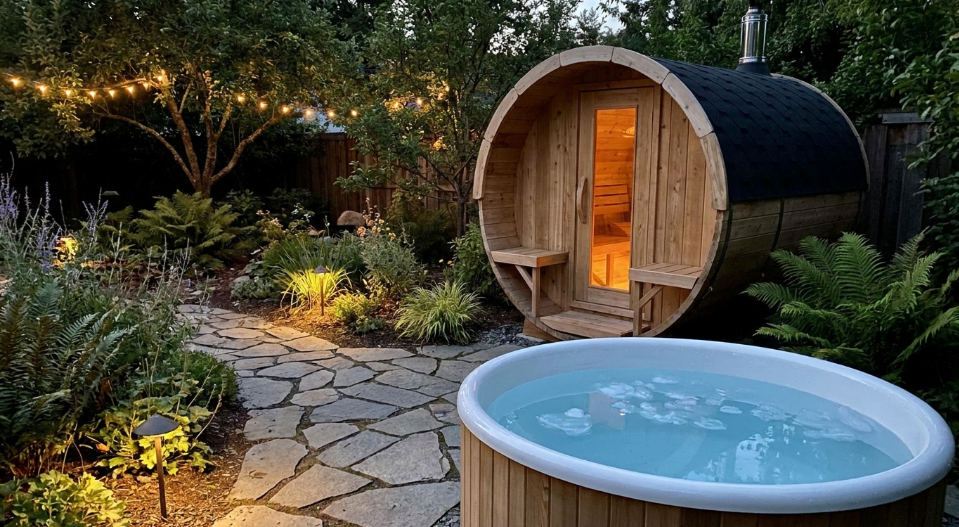
A backyard contrast setup usually pairs a small traditional cabin sauna, often 4 by 6 feet or larger, with a separate cold plunge tub or chiller unit placed a few steps away, close enough to move between them quickly without losing too much heat retention from the skin. Placing the plunge in shade and the sauna in a sunnier spot, where the yard allows it, can help both units run more efficiently across seasons.
7. What to Check Before Buying Either Piece
Because the sauna side of contrast therapy has the stronger research backing, it is worth prioritizing heater sizing and cabin quality on that half of the setup, then adding a cold plunge once the sauna itself is dialed in. SweatDecks is one of several specialty retailers that lists both traditional sauna cabins and cold plunge equipment with clear sizing and filtration specs, which is useful for comparing options before committing to a full contrast setup.
8. Common Setup Mistakes to Avoid
Placing the plunge too far from the sauna is one of the most common layout mistakes, since walking a long distance between hot and cold exposure lets skin temperature drift back toward neutral before the cold immersion even starts, blunting the contrast effect. Undersizing the cold plunge’s filtration or chiller capacity for how often it will actually be used is another frequent issue, since a unit that cannot recover temperature quickly between sessions becomes a bottleneck on busy days. On the sauna side, the most common mistake is treating heater sizing as an afterthought once the cold plunge has already eaten most of the budget, which leads to an underpowered heater that never quite reaches the temperatures needed for a real contrast effect.
9. Tracking Whether the Routine Is Actually Working for You
Because the research support is stronger for sauna frequency than for any specific contrast protocol, it helps to track how the practice feels and performs for you individually rather than assuming a fixed routine is optimal. Simple measures, resting heart rate trend over weeks, sleep quality, or how joints and muscles feel the day after a session, give a more personal read than trying to replicate a study’s exact parameters. Adjusting round length, water temperature, or frequency based on how your own body responds, rather than chasing a specific published protocol, is a reasonable way to use the evidence as a starting point rather than a strict prescription.
Frequently Asked Questions
What is contrast therapy with a sauna and cold plunge?
Contrast therapy alternates hot exposure in a sauna with cold exposure in a plunge pool or cold tub, typically several rounds of a few minutes each, followed by rest. The practice is popular for recovery and relaxation, though the research on its benefits is stronger for the sauna side than the cold side.
Does cold plunging after a sauna cancel out the benefits?
There is no strong evidence that a cold plunge cancels the cardiovascular associations linked to sauna bathing. Cold-water immersion has separate, mixed evidence of its own, and some research suggests it may blunt strength and muscle gains when used right after resistance training specifically.
How cold should the plunge be for contrast therapy?
Most people who practice contrast therapy use water in the 50 to 60 degree Fahrenheit range for one to three minutes per round, though there is no single studied optimal temperature and personal tolerance varies a great deal.
Is contrast therapy safe for everyone?
The rapid shift between hot and cold puts real stress on the cardiovascular system, so people with heart conditions, uncontrolled blood pressure, or who are pregnant should get medical guidance before trying it, and anyone should ease in gradually rather than starting with long extreme sessions.
References
- Association between sauna bathing and fatal cardiovascular and all-cause mortality events, JAMA Internal Medicine, 2015.
- Joint associations of sauna bathing and cardiorespiratory fitness on cardiovascular and all-cause mortality risk: a long-term prospective cohort study, Annals of Medicine, 2018.
- Short-term effects of Finnish sauna bathing on blood-based markers of cardiovascular function in non-naive sauna users, Heart and Vessels, 2018.
- Effects of cold-water immersion on health and wellbeing: A systematic review and meta-analysis, PLoS One, 2025.